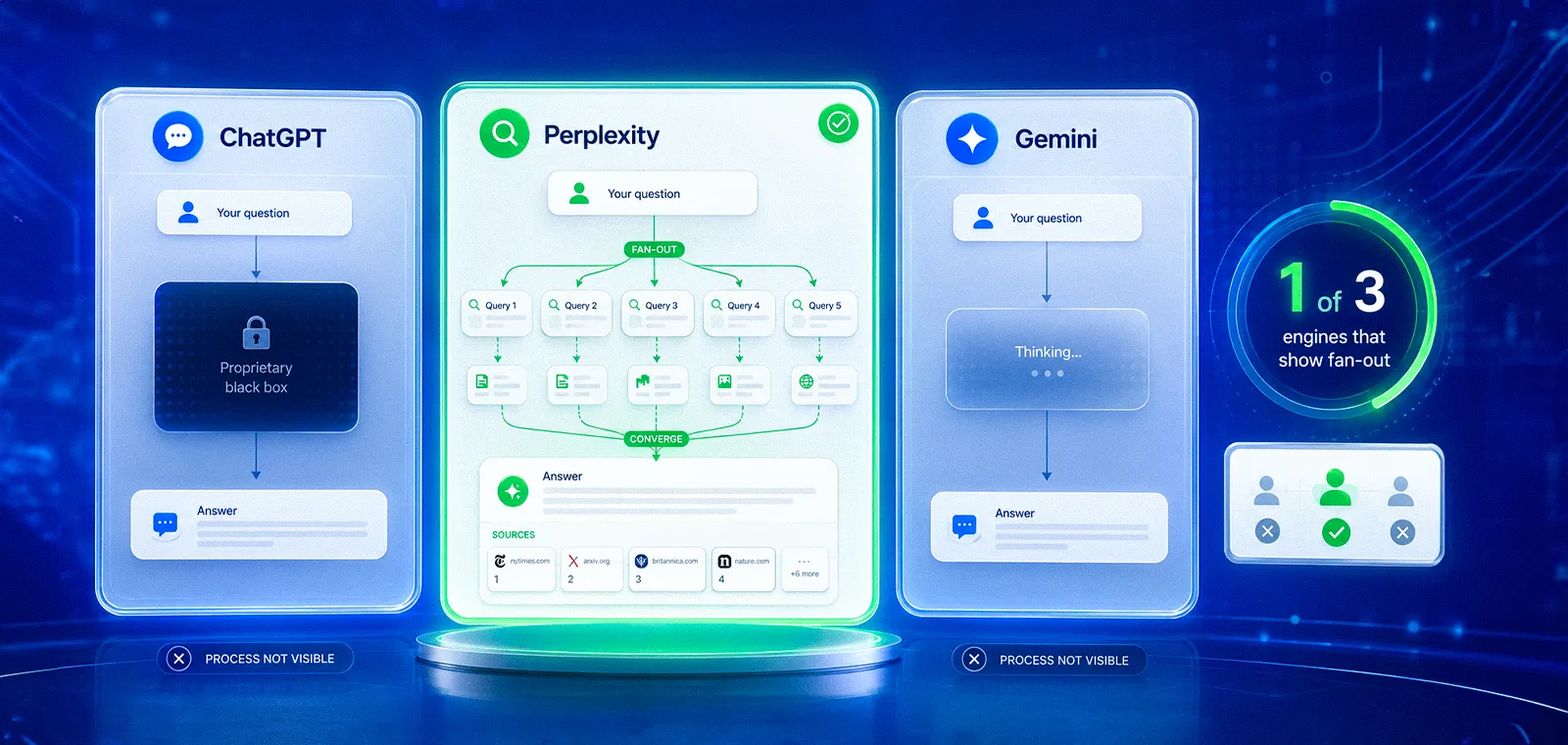
The claim: “Optimize for the query fan-out” is sound advice, but only one of the three major AI engines actually shows you the fan-out. For the other two you are guessing. What would prove it wrong: ChatGPT or Perplexity exposing a real, expanded fan-out (sub-queries different from the head question) at a rate comparable to Gemini.
The GEO playbook says to cover the fan-out: the set of sub-questions an AI engine breaks your query into before it answers. It is good advice with a practical problem. We pulled the fan-out each engine reports on the same 25 head queries (reusing the corpus from our cross-engine citation study), and only Gemini actually shows it. It expands every head query into 2.76 sub-questions per answer, 2.60 of them genuinely new, on 100% of answers. ChatGPT reports a fan-out of exactly 1.00, which is the head query echoed back, never expanded. Perplexity reports none.
Hypothesis
Pre-registered before analysis. All three engines decompose queries internally, but they differ in what they expose. We expected at least one to surface a usable fan-out and at least one to hide it. Falsifier: every engine exposing an expanded fan-out at a similar rate, which would make fan-out a universal, observable target.
Dataset
- Corpus: the same 25 brand-neutral, global-English head queries and their ChatGPT / Gemini / Perplexity responses collected for the cross-engine citation study. No new API calls.
- Signal: the
fan_out_queriesfield each engine returns alongside its answer. We count, per engine, the fan-out queries per answer, how many differ from the head query (a real expansion versus an echo), and the share of answers that expand at all. - Collected: 2026-06-14. Provenance: Public / self-collected data only. No client data anywhere.
Method
- For each saved response, read
fan_out_queries. - Normalise and compare each fan-out query to its head query. A fan-out query that differs is a real expansion; one identical to the head query is an echo.
- Aggregate per engine: fan-out per answer, expansions per answer, percent of answers that expand. Join citations per answer from the cross-engine study.
Results
| Engine | Fan-out / answer | Real expansions / answer | % answers expanding | Citations / answer |
|---|---|---|---|---|
| ChatGPT | 1.00 | 0.00 | 0% | 4.24 |
| Perplexity | 0.00 | 0.00 | 0% | 7.80 |
| Gemini | 2.76 | 2.60 | 100% | 10.32 |
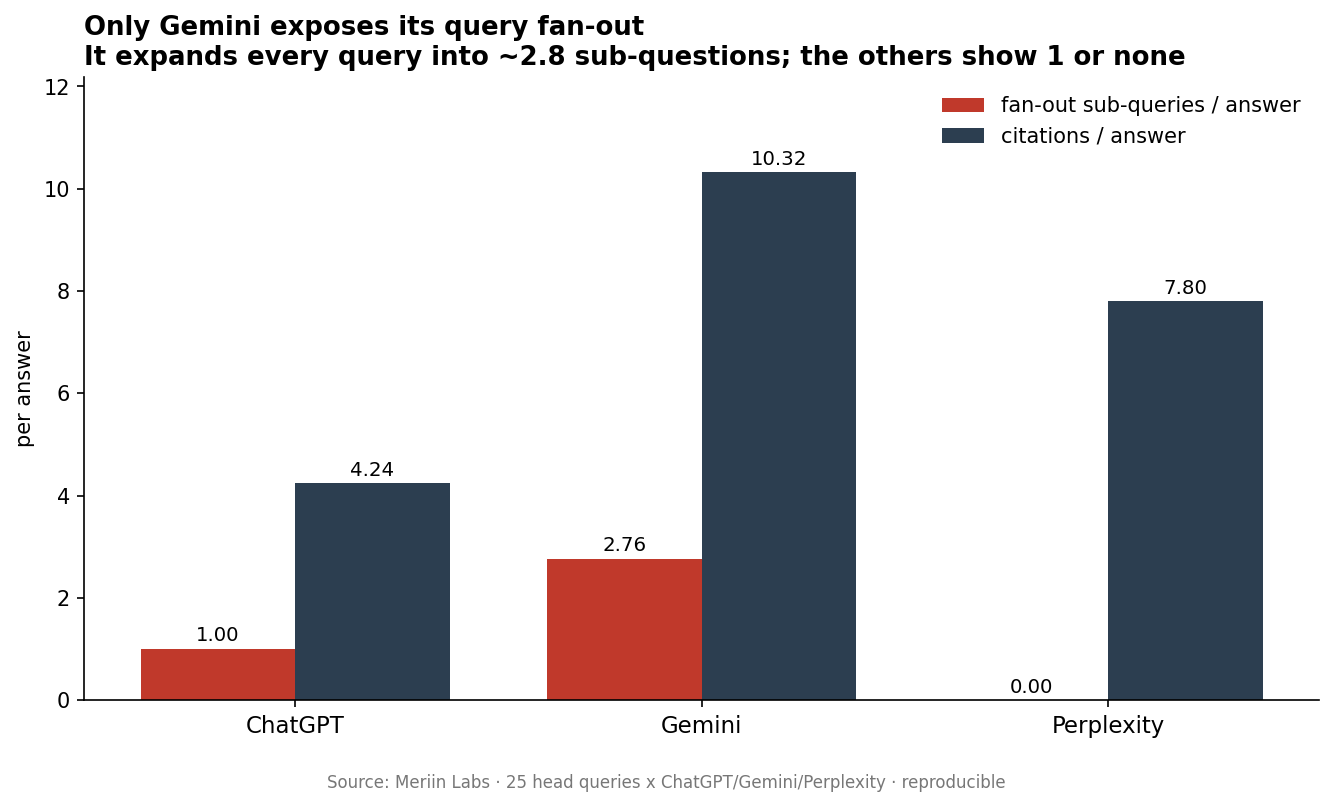
Finding 1: only Gemini shows its work. It produced 69 fan-out sub-queries, all distinct, from 25 head queries. ChatGPT’s “fan-out” is the question echoed back. Perplexity exposes nothing, which is an absence of disclosure, not proof it does not decompose.
Finding 2: the expansions are aspect-based and usable. For “what actually happens to your body during intermittent fasting,” Gemini’s fan-out was a reformulation plus “body changes,” “benefits of intermittent fasting,” and “risks of intermittent fasting.” That is a concrete content checklist: the sub-topics a page must cover to be retrievable for that query on Gemini.
Finding 3: fan-out tracks citation volume, but does not fully explain it. The most-expanding engine (Gemini, 2.76) also cites the most (10.32). But Perplexity cites heavily (7.80) while exposing no fan-out at all. So broad retrieval is not exclusively a visible-fan-out phenomenon, and you cannot infer an engine’s decomposition from its citation count alone.
Confidence
- What each engine exposes (Tier-A). A full census of the corpus. The 2.76 / 1.00 / 0.00 split is exact.
- What it means (read carefully). This measures disclosure, not internal behaviour. ChatGPT and Perplexity may decompose queries internally; they simply do not return the decomposition. The actionable fact stands: today, Gemini is the only one of the three you can optimise against by reading its fan-out.
Limitations
- Disclosure, not mechanism. Absence of an exposed fan-out is not absence of decomposition.
- Pilot scale. 25 head queries, English, informational. Directional, not per-vertical.
- One snapshot. What an engine exposes can change between releases; the appendix lets anyone re-run.
How this compares to prior work
GEO writing treats “the fan-out” as a single observable thing to optimise for. The data says fan-out observability is engine-specific: a real, readable checklist on Gemini, an echo on ChatGPT, and a black box on Perplexity. The practical move is to harvest Gemini’s fan-out directly (it is handed to you) and treat it as a strong proxy for the others, rather than assuming a universal fan-out you can see everywhere.
Reproduce this
In data/query-fanout/:
fanout.py: reads the S4 corpus and computes the per-engine fan-out stats.fanout_queries.csv: every fan-out query, tagged as expansion or echo.FIGURES-LEDGER.csv: every number in this article.
Run python3 fanout.py (it reads ../cross-engine-citations/raw/, so run the S4 collection first).
The number
On 25 head queries, only Gemini exposed a real query fan-out, expanding every question into 2.76 sub-queries (2.60 genuinely new), on 100% of answers. ChatGPT echoed the question; Perplexity showed nothing. If you optimise for “the fan-out,” you can read it on exactly one of the three engines.
Changelog & validity
- Valid as of 2026-06-14. Reflects what each engine exposed via the DataForSEO LLM Responses API on that date.
- Will be re-run at larger scale; a coverage phase (scoring how well cited sources answer each fan-out sub-query) is the planned extension.
- v1.0, 14 June 2026: first publication under the Meriin Labs team byline. Reuses the S4 corpus; figures-ledger written.
Want your category’s Gemini fan-out mapped to a content checklist? → Book a growth audit
Related: AI engines barely agree on sources · More from Meriin Labs
Back to the Lab