
The claim: The programmatic-SEO playbook (mint thousands of template pages, watch them compound) mostly mints dead pages. The traffic concentrates in a tiny fraction; the rest is index bloat. What would prove it wrong: programmatic sites showing most of their pages earning meaningful traffic, with a thin zero-traffic tail.
Everyone cites the same programmatic-SEO winners. Almost no one looks at the denominator. We pulled the page-by-traffic distribution for four programmatic sites (Zillow, TripAdvisor, Yelp, G2) and two editorial sites for contrast, straight from Ahrefs. The programmatic four hold roughly 11.3 million pages between them, and on average 97.5% of those pages earn 100 organic visits a month or fewer, with 35.1% earning essentially zero. The compounding everyone admires lives in well under one percent of the inventory.
Hypothesis
Pre-registered before pulling the data. Programmatic page inventories follow an extreme power law: a sliver of pages carries the traffic, and the long tail is dead. Editorial sites, with fewer and more deliberate pages, should carry proportionally less dead weight. Falsifier: programmatic dead-weight share comparable to editorial.
Dataset
- Sites (6): programmatic, zillow.com, tripadvisor.com, yelp.com, g2.com; editorial (contrast), investopedia.com, nerdwallet.com.
- Metric: Ahrefs
pages-by-traffic, the count of pages in each organic-traffic bucket (0, 1 to 100, 100 to 1k, 1k to 5k, 5k to 10k, 10k+), per site, as of 2026-06-14. - Derived: total indexed pages; dead (= the 0-traffic bucket); near-dead (= 100 visits/mo or fewer); share of traffic in the top bucket.
- Provenance: Public data only. Public companies, public Ahrefs metrics, saved verbatim. No client data.
Method
- For each site, sum the buckets to get total pages and total traffic.
- Compute the share of pages earning ~0 traffic (dead) and 100/mo or fewer (near-dead), and the share of all traffic coming from the top bucket.
- Group by site type and compare.
Site labels are by business model. Ahrefs page counts are estimates, so treat totals as orders of magnitude.
Results
| Site | Type | Total pages | Dead (~0) | 100/mo or fewer | Top-bucket traffic share |
|---|---|---|---|---|---|
| yelp.com | programmatic | 7,308,684 | 28.8% | 98.1% | 27.5% |
| tripadvisor.com | programmatic | 2,974,923 | 31.0% | 96.7% | 14.4% |
| zillow.com | programmatic | 960,439 | 33.0% | 96.6% | 37.4% |
| g2.com | programmatic | 66,701 | 47.7% | 98.4% | 9.6% |
| investopedia.com | editorial | 26,903 | 16.9% | 65.0% | 46.0% |
| nerdwallet.com | editorial | 8,935 | 8.8% | 53.1% | 51.1% |
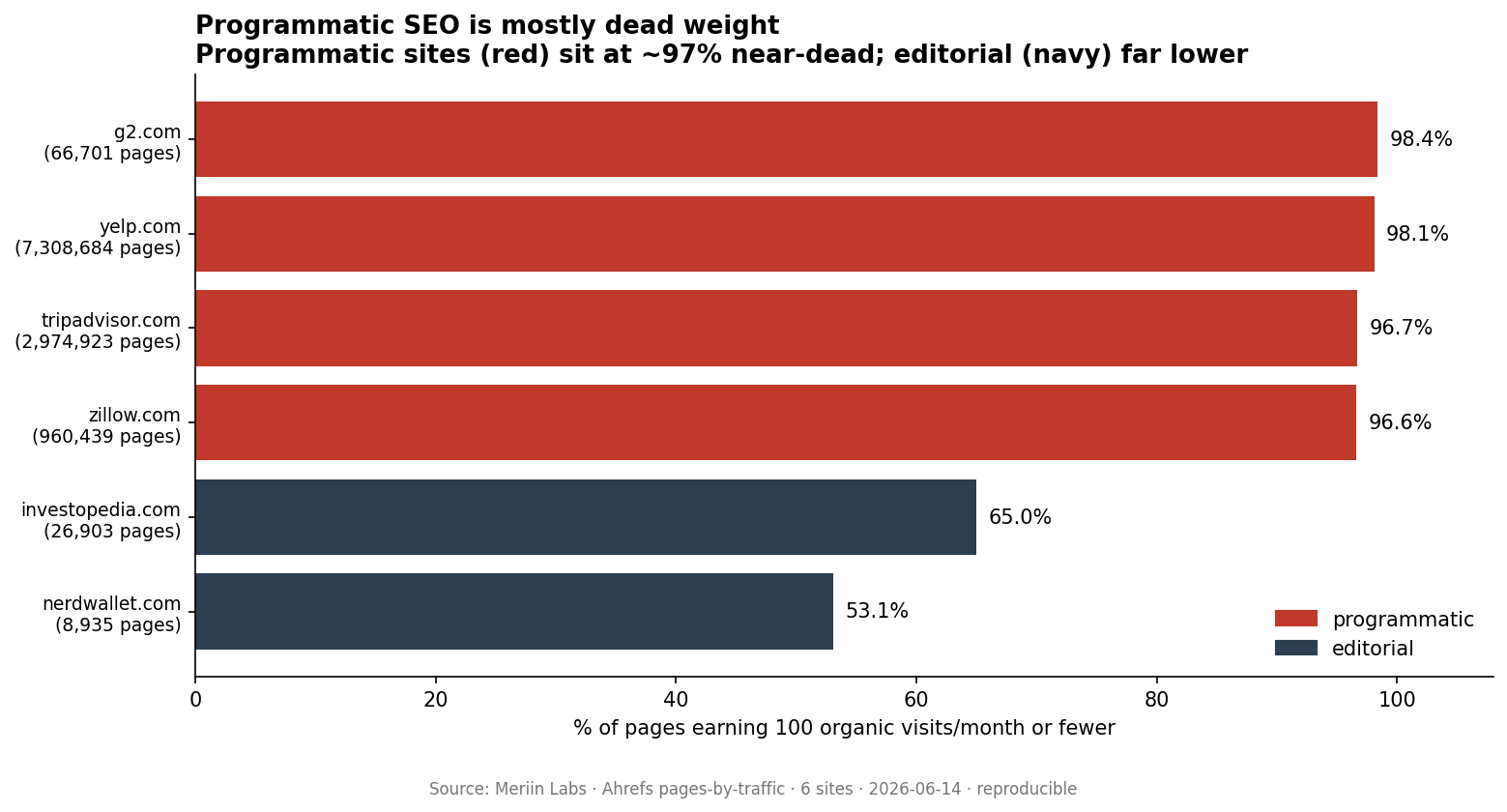
Finding 1: programmatic inventories are ~97% near-dead. The four programmatic sites average 97.5% of pages at 100 visits/mo or fewer and 35.1% at zero. G2, the smallest, is the deadest by share (47.7% zero).
Finding 2: editorial carries far less dead weight. The editorial pair averages 59.0% near-dead and 12.8% dead, roughly a third of the programmatic dead-weight rate, on inventories two to three orders of magnitude smaller.
Finding 3: the traffic lives in a sliver. For every programmatic site, the top bucket (pages over 10k/mo) is a rounding error of the page count yet carries a double-digit share of traffic. The model is not “many pages each earning a little.” It is “a handful of pages earning almost everything, sitting on a mountain of dead ones.”
Confidence
- The distributions (Tier-A). Full Ahrefs buckets, summed by script. The 97.5% near-dead figure is real for this set.
- Labels and counts (Tier-B). “Programmatic” vs “editorial” is assigned by business model, and Ahrefs page counts are estimates. The gap is large enough (97.5% vs 59.0%) to survive both caveats.
Limitations
- Six sites. Illustrative, not a census of the web. The pattern is consistent and extreme, but base rates will vary by vertical.
- Estimated page counts. Ahrefs does not see every URL; totals are orders of magnitude, not exact inventories.
- Dead is not useless. A zero-traffic page can still serve internal linking, conversions, or long-tail capture below Ahrefs’ detection floor. “Dead” here means “earns ~0 measurable organic traffic,” not “worthless.”
- Snapshot. One date; the distribution moves with algorithm updates.
How this compares to prior work
The programmatic-SEO canon is a highlight reel of survivors: the template that printed millions of visits. This is the rest of the tape. On these four sites, building at programmatic scale produced overwhelmingly dead inventory, and the celebrated compounding was concentrated in a fraction of a percent of pages. That does not make programmatic SEO wrong; Zillow and Yelp still pull tens of millions of visits. It means the unit of success is not “pages shipped.” A program that judges itself by page count is measuring its dead weight. The honest metric is the share of template pages that clear a real traffic threshold, and on this evidence that share is small.
Reproduce this
In data/programmatic-decay/:
raw/*.json: each site’s Ahrefs page-by-traffic buckets, saved verbatim with provenance.analyze.py: computes dead, near-dead, and traffic-concentration per site.site_stats.csv,FIGURES-LEDGER.csv: the results and every number in this article.
Run python3 analyze.py. Add a site by dropping a raw file with a site_type.
The number
Four programmatic-SEO sites (Zillow, TripAdvisor, Yelp, G2) hold ~11.3 million pages between them. An average 97.5% earn 100 organic visits a month or fewer, and 35.1% earn essentially zero. Editorial sites carry far less dead weight (59.0% near-dead). At programmatic scale, the page is not the unit of success; the surviving fraction is.
Changelog & validity
- Valid as of 2026-06-14. Reflects Ahrefs page-by-traffic estimates pulled that date.
- A larger panel and a per-template-type cut are the planned extensions.
- v1.0, 14 June 2026: first publication under the Meriin Labs team byline. Six sites, figures-ledger written.
Wondering what share of your pages actually earn their keep? → Book a growth audit
Related: Loop type doesn’t predict SEO trajectory · More from Meriin Labs
Back to the Lab